
Contribution Web app In Progress 2026
Cloud Native Peshawar — CNCF Community Platform
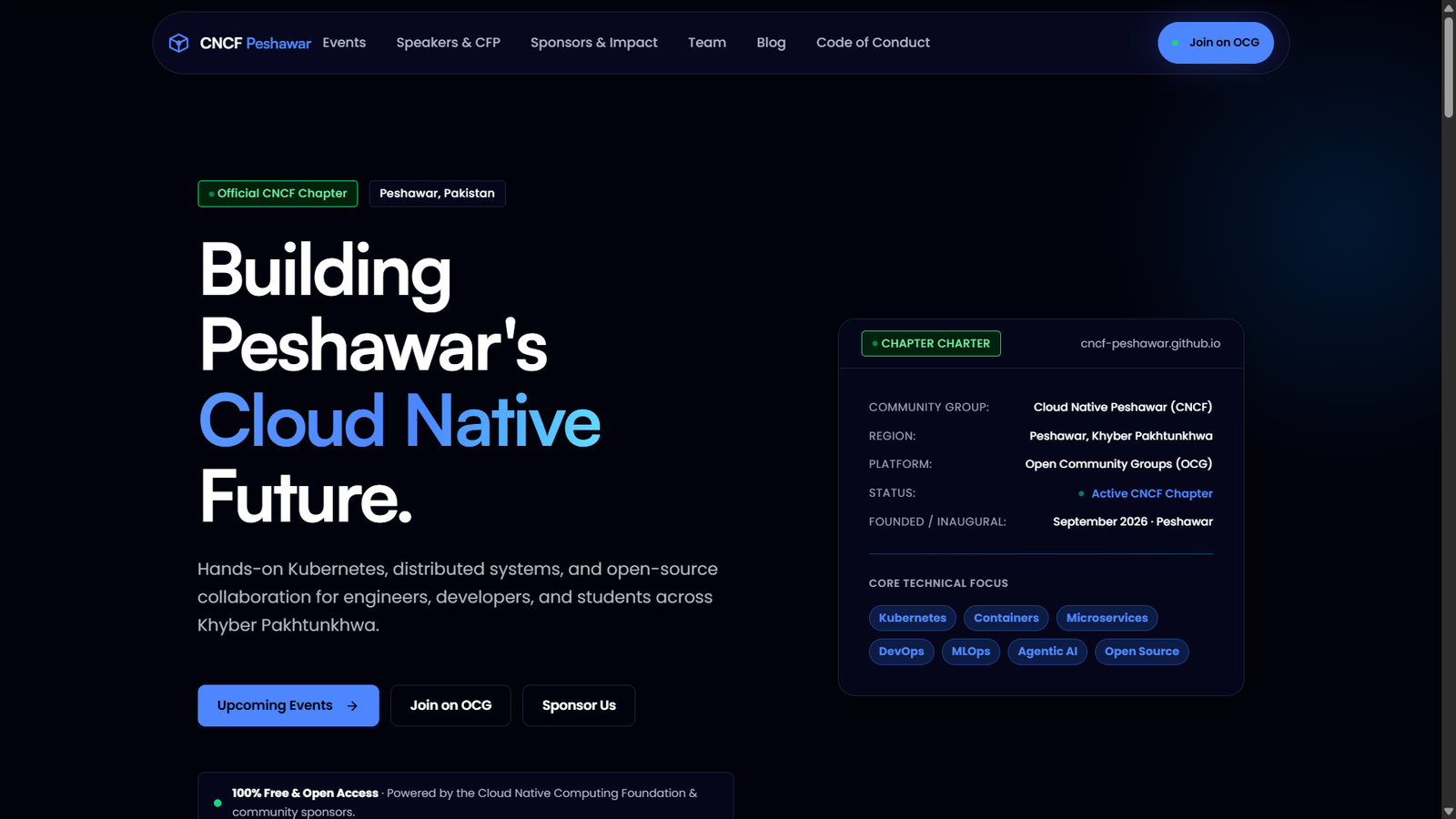
A community platform for the official Cloud Native Computing Foundation (CNCF) chapter in Peshawar, Pakistan, connecting developers, students, and open-source enthusiasts through technical meetups, workshops, and community initiatives. The website showcases events, organizers, sponsors, speaking opportunities, and resources focused on Kubernetes, cloud-native engineering, DevOps, distributed systems, and open-source collaboration.
Case Study: Cloud Native Peshawar — Building a Community for Cloud-Native Innovation
1. Project Overview
Cloud Native Peshawar is a community platform for the Cloud Native Computing Foundation (CNCF) chapter in Peshawar, Pakistan. Its mission is to bring together developers, software engineers, DevOps professionals, university students, and open-source enthusiasts to learn, collaborate, and explore modern cloud-native technologies.
The website serves as the community's digital hub, connecting visitors with technical events, hands-on workshops, speaker opportunities, community organizers, sponsors, and learning resources. Its focus is on making cloud-native engineering more accessible while helping local developers connect with the wider open-source ecosystem.
The platform emphasizes practical learning, technical collaboration, and community growth, with a focus on Kubernetes, containers, microservices, distributed systems, DevOps, MLOps, and emerging technologies such as Agentic AI.
2. The Problem
Cloud-native technologies are increasingly important in modern software engineering, but students and early-career developers may find it difficult to access practical learning opportunities, connect with experienced engineers, and gain exposure to real-world infrastructure challenges.
Learning resources alone do not always provide the collaborative environment needed to build practical skills. Developers also benefit from hands-on labs, technical discussions, mentorship, networking, and opportunities to share their knowledge with others.
Local technology communities can help bridge this gap by bringing people together around shared interests and creating accessible spaces for technical learning.
The challenge was to provide a central digital platform that could communicate the community's mission, make events easier to discover, encourage technical participation, and connect local talent with the broader cloud-native ecosystem.
3. The Solution
The Cloud Native Peshawar website provides a central online destination for the community's activities, technical focus areas, and participation opportunities.
The platform organizes information into dedicated sections that help visitors understand the community, explore events, connect with organizers, and discover ways to contribute.
Its core capabilities include:
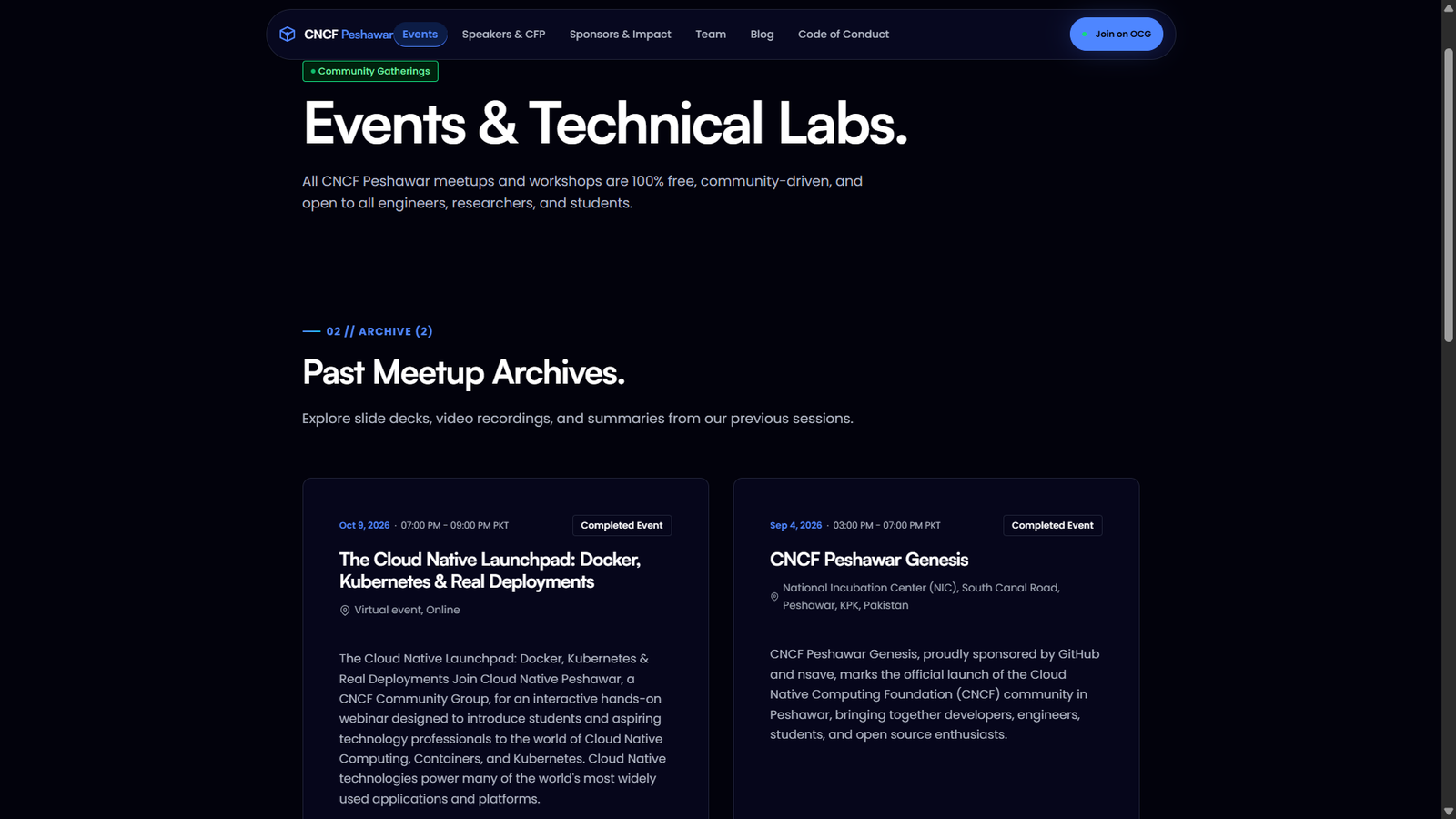
- Events and meetups: Showcasing community events, technical sessions, and hands-on learning opportunities.
- Speakers and Call for Proposals (CFP): Providing a pathway for developers and engineers to propose talks and share technical knowledge.
- Sponsors and community impact: Recognizing partners and communicating the support that helps make community activities accessible.
- Team and organizers: Introducing the people responsible for organizing and supporting the community.
- Blog and event recaps: Providing a space for updates and resources associated with community activities.
- Community resources: Connecting visitors with the broader open-source and cloud-native ecosystem.
Together, these sections create a structured experience for visitors who want to learn about the community, attend events, contribute as speakers, or support its activities.
4. Core Technical Focus
The website reflects the community's emphasis on practical cloud-native engineering.
Kubernetes and Containerization
Kubernetes and containers are central to modern cloud-native application deployment. The community promotes learning opportunities that help participants understand containerized workloads, orchestration, deployment, and scaling.
Microservices and Distributed Systems
The community's technical focus includes understanding how distributed applications are designed, deployed, observed, and maintained.
DevOps and Infrastructure
Practical infrastructure topics include deployment workflows, automation, networking, and production-oriented engineering practices.
MLOps and Agentic AI
The platform also highlights emerging areas at the intersection of cloud-native infrastructure, machine learning operations, and AI-driven systems.
These topics help establish the technical direction of the community and give developers a clearer picture of the subjects they can explore through its activities.
5. Hands-On Learning and Community Engagement
A major part of the community's approach is to go beyond introductory presentations and encourage practical experimentation.
The website describes hands-on labs in which participants can work with local Kubernetes environments, deploy microservices, and inspect network traffic. It also highlights opportunities for engineers to receive support in preparing technical talks and developing presentation skills.
This approach supports learning through experimentation and collaboration.
For students, it provides a pathway to explore technologies commonly used in modern infrastructure. For experienced developers, it offers opportunities to share knowledge, discuss technical challenges, and contribute to the growth of the local engineering community.
6. Digital Experience and Website Structure
A community website must serve several audiences, including event attendees, potential speakers, sponsors, organizers, and newcomers to cloud-native technologies.
The platform addresses these needs through dedicated content areas and clear participation pathways.
Information Architecture
Organizing events, speaker opportunities, sponsors, team information, and community resources into distinct sections helps visitors find relevant information efficiently.
Community Identity
The website communicates a consistent identity for Cloud Native Peshawar and presents the chapter's mission, technical focus, and community values.
Participation Pathways
Links to community platforms, event information, speaker submissions, and sponsorship opportunities give visitors different ways to become involved.
Accessibility of Opportunities
The website emphasizes free and open access to community meetups and workshops, helping communicate that participation is not limited to a paid membership.
The overall objective is to make the website useful not only as an informational page but also as an entry point into the community.
7. Technology and Development
The project is published through GitHub Pages at https://cncf-peshawar.github.io/.
GitHub Pages provides hosting for the website and connects the project to GitHub's source-control and collaboration ecosystem.
The exact frontend framework, programming languages, styling libraries, build tools, and external integrations should be documented based on the source repository. The live website alone does not establish the complete implementation stack, so this case study does not assume unverified technologies.
From a development perspective, the project involves several important considerations:
- Organizing content so that visitors can navigate the community's activities.
- Maintaining a consistent visual and informational structure.
- Presenting event information and participation links clearly.
- Supporting usability across desktop and mobile devices.
- Keeping community information and event details up to date.
- Maintaining a website that can evolve alongside the community.
8. Community Partnerships and Open-Source Collaboration
The website highlights partners that support the community's activities, including GitHub, the National Incubation Center (NIC) Peshawar, and nsave in connection with the CNCF Peshawar Genesis event.
These partnerships illustrate how technology communities can collaborate with organizations that provide resources, venues, and support for community-led initiatives.
The platform also connects visitors with community channels, the GitHub organization, professional networking platforms, and the wider CNCF ecosystem.
By making these connections visible, the website supports collaboration between developers, organizers, sponsors, and other participants interested in advancing cloud-native engineering.
9. Challenges and Engineering Considerations
Building and maintaining a community platform involves more than presenting static information. It requires balancing technical clarity, content organization, and the changing needs of a growing community.
Organizing diverse content: Events, speakers, sponsors, resources, and team information serve different audiences and need to remain easy to discover.
Maintaining accurate information: Event schedules, registration details, speaker opportunities, and community links must be kept current.
Encouraging participation: The website needs to make it clear how visitors can attend events, submit talks, contribute to the community, or explore learning resources.
Supporting community growth: As new events and initiatives are introduced, the website must be able to accommodate additional information without becoming difficult to navigate.
Connecting local and global communities: The platform needs to communicate local opportunities while making relevant open-source resources and community channels accessible.
These considerations help shape a website that supports the community's ongoing activities rather than functioning only as a one-time announcement.
10. Future Improvements
Potential improvements, depending on the existing implementation and community requirements, could include:
- A searchable archive of past events, talks, and technical workshops.
- Dedicated speaker profiles and presentation resources.
- A structured learning-resource directory for cloud-native technologies.
- Improved event discovery and registration workflows.
- More detailed event recaps, photographs, and recordings.
- Community contribution guides and beginner-friendly onboarding.
- Performance, accessibility, and search-engine optimization improvements.
- A content-management workflow that makes updates easier for organizers.
These improvements could help the website become an increasingly valuable resource for both new and established members of the cloud-native community.
11. Project Significance
Cloud Native Peshawar demonstrates how a digital platform can support technical education and open-source community development.
By connecting event information, technical learning opportunities, speaker participation, community partners, and open-source resources, the website provides a foundation for bringing developers together around shared engineering interests.
Its significance lies in connecting technology with community building. Cloud-native engineering becomes more accessible when people have opportunities to learn together, experiment with real tools, share knowledge, and develop professional relationships.
The platform also helps communicate the potential of local technology communities to participate in broader conversations about modern infrastructure, distributed systems, and open-source innovation.
12. Conclusion
The Cloud Native Peshawar website is a community-focused digital platform designed to support cloud-native learning, technical collaboration, and open-source engagement in Peshawar, Pakistan.
By bringing events, speaker opportunities, sponsors, organizers, and technical resources into one online destination, the platform helps visitors understand the community's mission and discover ways to participate.
The project illustrates an important role for web development beyond traditional business applications: building digital infrastructure that connects people, supports knowledge sharing, and strengthens technical communities.
The broader vision is to help local developers learn, build, and collaborate with the global cloud-native ecosystem—while contributing to the growth of technology and open-source innovation in the region.
Next project
Cola Next — Distributor Management System ›