
Product Web app Shipped 2026
Note Taking API – RESTful Notes Management
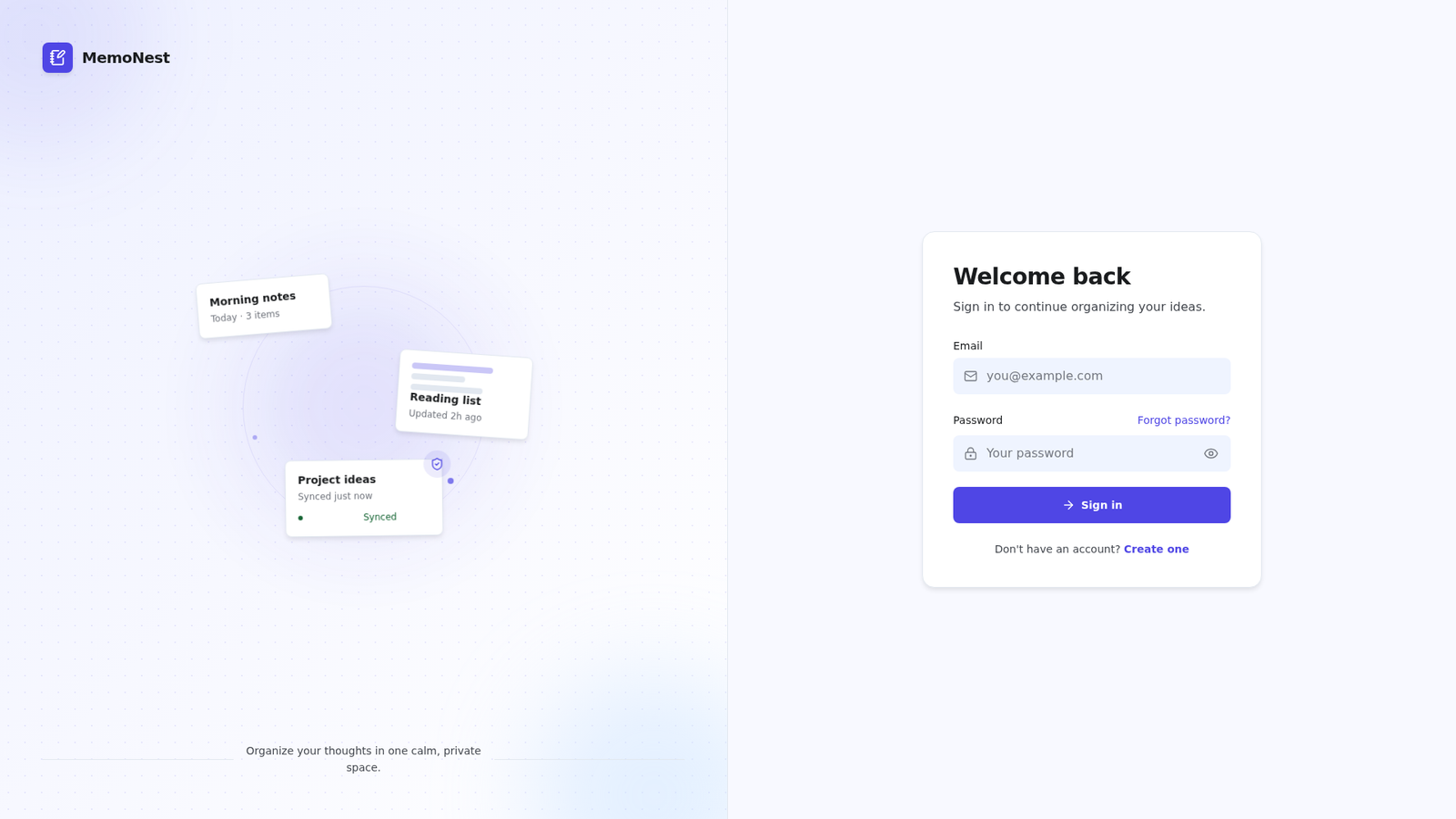
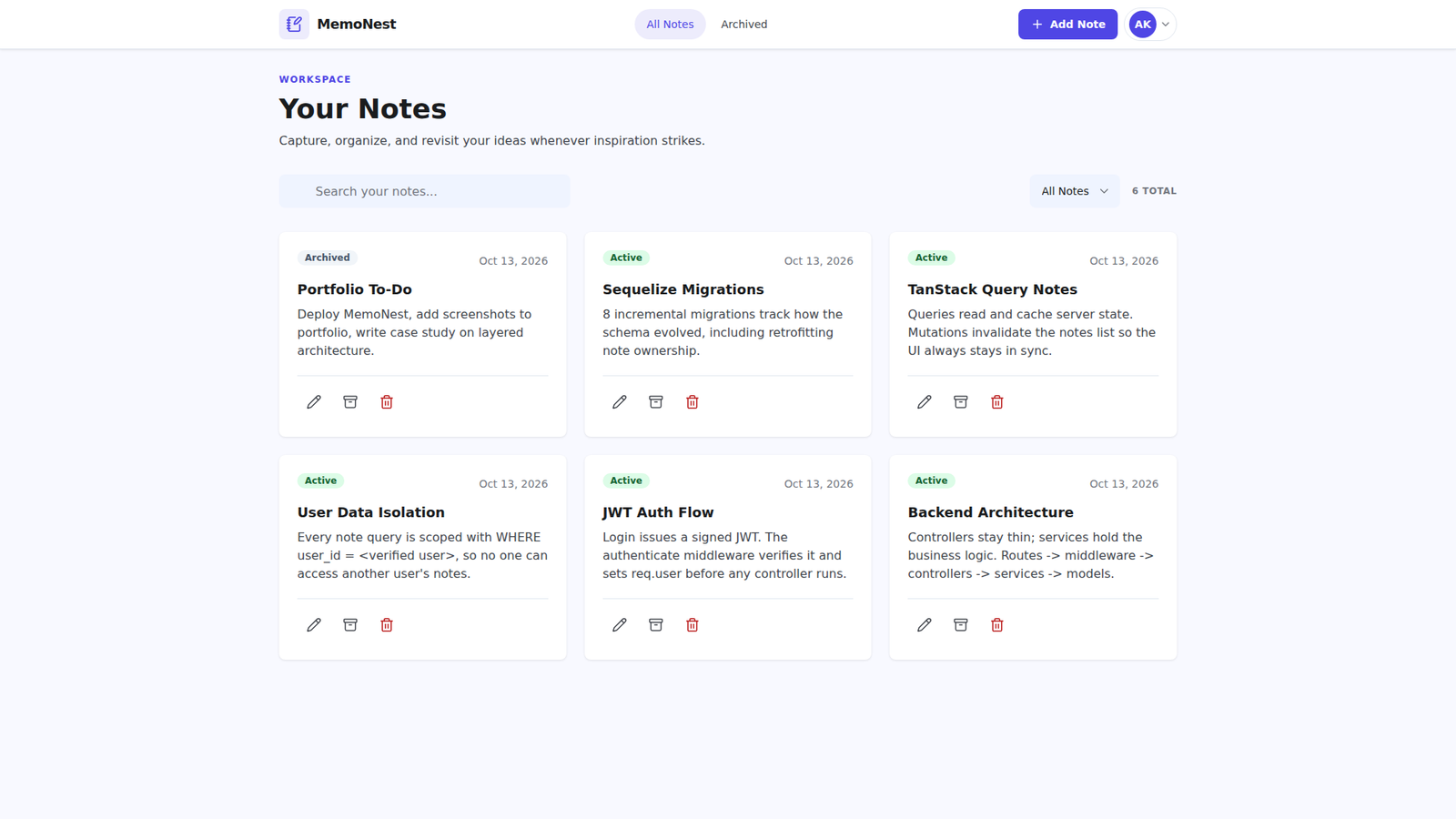
MemoNest is a note-taking application where a user can register, sign in, and manage a personal, private collection of notes — creating, editing, archiving, and deleting them. Every note belongs to exactly one user, and the backend guarantees that a user can never read, edit, or delete another user's notes, even if they know that note's ID
Case Study: Note Taking API — A RESTful Backend for Note Management
1. Project Overview
The Note Taking API is a backend development project focused on providing a structured API for managing notes. It is designed to serve as the server-side foundation of a note-taking application, enabling clients to interact with note data through HTTP requests.
The project explores the fundamentals of backend engineering, including API design, request handling, data management, and organizing application logic into maintainable components.
By separating backend functionality from the user interface, the API can serve as a foundation for different client applications, such as web applications, mobile apps, or other services that need to manage notes.
2. The Problem
Note-taking applications need a reliable way to create, access, modify, and delete information. Without a well-structured backend, these operations can become difficult to maintain, reuse, and integrate with different client applications.
A dedicated API addresses this challenge by defining a consistent communication layer between the client and the server.
The main objectives of this project are to explore how backend services can:
- Accept and process HTTP requests.
- Organize note-management operations through API endpoints.
- Handle incoming data and server responses consistently.
- Separate application logic from client-side presentation.
- Provide a foundation for future application features.
3. The Solution
The Note Taking API provides a backend-oriented approach to note management through RESTful API design.
Instead of tying note operations to a particular interface, the project focuses on making those operations accessible through an API. This separation allows a frontend application to communicate with the backend without needing to know how the server processes or stores the underlying data.
The core note-management workflow can be organized around four standard operations:
- Create: Submit a request to add a new note.
- Read: Retrieve existing note information.
- Update: Modify an existing note.
- Delete: Remove a note when it is no longer needed.
These operations represent the typical requirements of a CRUD-based application. The exact endpoints, data model, and implementation details should be confirmed from the repository before being documented as completed features.
4. API Design and Backend Architecture
A well-designed API should provide a predictable interface for client applications.
The project provides an opportunity to apply REST principles, including the use of HTTP methods, resource-oriented endpoints, and appropriate response structures.
For example, a note resource might support operations corresponding to POST, GET, PUT or PATCH, and DELETE. Each request should communicate its outcome through an appropriate HTTP status code and a response that clients can interpret.
A maintainable backend can also benefit from separating responsibilities such as:
- Routing: Directing requests to the appropriate handlers.
- Request handling: Processing incoming parameters and payloads.
- Business logic: Applying the rules associated with note operations.
- Data access: Reading and modifying stored information.
- Error handling: Returning meaningful errors when requests cannot be completed.
These are architectural considerations for a reliable note-taking backend; the repository's actual structure should determine which of them are included in the final technical description.
5. Data Management and Validation
Managing notes requires a clear representation of the information being stored. A note may include fields such as a title, content, and timestamps, depending on the application's data model.
Input validation is an important part of this process. The backend should check incoming data before processing it, helping prevent invalid requests from producing unexpected results.
A robust implementation should also account for situations such as requests for nonexistent notes, missing required fields, malformed payloads, and unexpected server errors.
The specific database, validation library, and persistence strategy used by this project should be documented after inspecting its source code and dependency configuration.
6. Error Handling and Reliability
A useful API must communicate both successful operations and failures clearly.
For example, a client should be able to distinguish between a successfully retrieved note, an invalid request, a resource that cannot be found, and an unexpected server-side failure.
Consistent error handling makes an API easier to integrate with frontend applications and simplifies debugging during development.
This project provides a practical context for learning how to handle these situations and build predictable server-side behavior.
7. Testing and Quality Considerations
Testing is essential for ensuring that API endpoints behave as expected.
A comprehensive testing strategy for a note-management API can include:
- Verifying that valid requests produce the expected responses.
- Checking that invalid inputs are handled correctly.
- Testing behavior when a requested note does not exist.
- Confirming that update operations preserve unrelated data.
- Ensuring that deletion behaves consistently.
- Checking error responses and relevant HTTP status codes.
These checks help establish confidence in the API and reduce the likelihood of regressions as the project evolves. The actual testing frameworks and completed test coverage should be confirmed from the repository.
8. Challenges and Engineering Considerations
Developing a backend API involves more than creating endpoints. Several engineering considerations influence its usability and maintainability.
Consistent API behavior: Endpoints should follow predictable conventions so client applications can interact with them easily.
Input validation: Invalid data should be rejected or handled appropriately before it affects application state.
Maintainable code: Separating responsibilities makes it easier to understand, debug, and extend the backend.
Reliable error responses: Clients need meaningful responses when requests fail.
Future extensibility: A clear API structure provides a foundation for adding functionality without unnecessarily complicating existing behavior.
These considerations form an important part of building backend services that are practical to use and easier to maintain.
9. Future Improvements
Depending on the current implementation, possible future enhancements could include:
- User authentication and authorization.
- Private notes associated with individual users.
- Search, filtering, and pagination.
- Note categories, tags, and organization.
- Created and updated timestamps.
- Automated unit and integration tests.
- API documentation using OpenAPI or Swagger.
- Deployment and automated CI checks.
These are potential improvements rather than claims about features already implemented.
10. Conclusion
The Note Taking API is a backend development project centered on the principles of API design and note management.
By exploring how client applications communicate with server-side services, the project provides a foundation for understanding HTTP requests, resource-oriented endpoints, data handling, validation, and error management.
The broader value of this work lies in building an understanding of how backend APIs support modern applications. A clear, reliable API can serve as the foundation for multiple client interfaces and can evolve as application requirements become more complex.
Next project
SheShield Mobile App ›